

Document number: P3XXX
Date: 2025-12-18
Project: Programming Language C++, WG21
Reply-to: [Author]
The Two-Decade Quest: C++ Contracts Through the Lens of Great Founder Theory
Abstract
This paper analyzes the 21-year trajectory of C++ Contracts—from the first proposal in 2004 to adoption in C++26 (2025)—using Great Founder Theory (GFT) as an analytical framework. We examine how the feature was added to C++20 in 2018, dramatically modified, and then removed entirely in 2019, leading to the formation of a dedicated study group (SG21) and a complete redesign. We name the key individuals, corporations, and decisions that shaped this outcome, and use this historical analysis to infer conclusions about the effectiveness of the committee process. Finally, we propose structural reforms and consider whether an alternative governance model is necessary to serve the evolving needs of the C++ community.
1. Introduction
C++ Contracts—language support for specifying preconditions, postconditions, and assertions—represent one of the most prolonged and contentious features in C++ standardization history. First proposed in 2004, added to the C++20 working draft in 2018, removed in 2019 after a “heated discussion” in Cologne, and finally adopted for C++26 in February 2025, the feature’s tortuous journey illuminates fundamental tensions in language standardization.
As Herb Sutter declared in 2018:
“Contracts is the most impactful feature of C++20 so far, and arguably the most impactful feature we have added to C++ since C++11.”
Yet within a year, the feature was unanimously removed. The subsequent five-year redesign effort produced P2900, a 119-page proposal that generated sustained opposition even as it progressed toward adoption.
Great Founder Theory provides a framework for understanding institutional dynamics: how vision-driven leadership enables progress, how its absence creates dysfunction, and how “borrowed” versus “owned” power shapes outcomes. Applied to WG21, GFT illuminates why Contracts repeatedly failed despite widespread agreement on its value, and what structural changes might prevent similar failures.
2. Timeline: Four Phases of Contracts
2.1 Phase One: Early Proposals (2004-2016)
The Ottosen Era (2004-2006):
The first formal proposal for Design by Contract in C++ appeared in N1613 (2004) by Thorsten Ottosen, heavily influenced by the D programming language. The proposal introduced:
preconditionandpostconditionblocksClass invariants
Inline violation handling
This evolved through four revisions:
N1669 (2004): Revision 1 (Ottosen)
N1773 (2005): Revision 2 (Dave Abrahams, Lawrence Crowl, Ottosen, Jeremy Widman)
N1866 (2005): Revision 3 (Crowl, Ottosen)
N1962 (2006): Revision 4 (Crowl, Ottosen)
Key design changes across revisions:
Keywords
in/outreplaced byprecondition/postconditionOld-value syntax evolved:
std::old(x)→__old(x)→oldof(x)“Importance ordering” (checking levels) added then removed
The Bloomberg BDE Foundation (2004-2014):
Parallel to committee work, John Lakos at Bloomberg developed a practical, library-based contract-checking facility called bsls_assert within Bloomberg’s BDE (Bloomberg Development Environment):
2004: First incarnation of
bde_assertconceived by Lakos2005: First production use outside infrastructure teams
2008: Major refactoring with fine-grained control
2012: Open-source release of BDE libraries incorporating
bsls_assert2013: First committee paper (N3604) by Lakos & Zakharov proposing standardization
Bloomberg’s experience would prove foundational. As documented in P1487:
“The ideas behind design-by-contract (DbC), defensive programming (DP), and undefined behavior (UB) along with the distinction between wide contracts (those having no preconditions) and narrow ones (those that do have preconditions) are first presented outside of Bloomberg at ACCU’09.”
The Lakos-Myers Language Proposal (2014-2015):
N4075 (2014): Final macro-based proposal—rejected at Rapperswil for heavy macro dependence
N4135 (2014): First language-based proposal from Bloomberg (Lakos, Zakharov, Beels, Myers)
N4378 (2015): “Language Support for Contract Assertions (Revision 10)” by Lakos, Myers, Zakharov, Beels
As P1487 notes:
“In fact, contracts as we know them today might never have come to be had Nathan Myers, then a member of the BDE team at Bloomberg, not come along.”
2.2 Phase Two: The Unified Proposal and C++20 Adoption (2016-2018)
The P0380 Merger:
In May 2016, a pivotal merger occurred. P0380R0 “A contract design” united two approaches:
Microsoft’s static-analysis-focused declaration annotations (N4435, Walter Brown)
Bloomberg’s runtime-checking and violation-handling experience (N4378)
Authors: Gabriel Dos Reis, J. Daniel Garcia, John Lakos, Alisdair Meredith, Nathan Myers, Bjarne Stroustrup
This collaboration represented an unusual alliance: Microsoft (Dos Reis), Academia (Garcia from UC3M), Bloomberg (Lakos, Myers, Meredith), and the language creator (Stroustrup).
P0542: The C++20 Contracts Proposal:
P0542 evolved through five revisions, culminating in P0542R5 (June 2018), which was adopted into the C++20 working draft. Key features:
int f(int x)
  [[expects: x > 0]]           // precondition
  [[ensures res: res > 0]]     // postcondition
{
  [[assert: x != 42]];         // assertion
  return x * 2;
}
Contract levels: default, audit, axiom Build modes: Determining which levels are checked Violation handler: Customizable response to failures
Implementation Progress:
GCC implemented the C++20 contracts proposal (P1680R0), providing the first compiler support.
2.3 Phase Three: The Cologne Crisis and Removal (2019)
The Kona Warning Signs (February 2019):
At the Kona meeting, significant concerns emerged about the design:
Unchecked contracts were “assumed” by default, introducing undefined behavior
The meaning of
axiomwas unclearNo consensus existed among the original authors on how to fix these issues
The Cologne Debacle (July 2019):
As Timur Doumler reported:
“In Cologne, we then had over a dozen papers on the table in EWG, pointing out those and other issues, and suggesting different, mutually incompatible solutions.”
Key papers included:
P1429 (Joshua Berne, John Lakos): “Contracts That Work”—redefining behavior in terms of named semantics
P1607: “Minimizing contracts”—removing levels entirely, using literal semantics
The Last-Minute Change:
EWG approved P1607, a significant redesign that removed contract levels and build modes in favor of literal semantics. However, this late change:
“eroded trust in the proposed design and ultimately caused WG21 consensus on the entire feature to evaporate.” (P2899R1)
The Evening Session:
A special evening session convened with contract paper authors:
“In this meeting, we talked in great detail about different use cases of contracts, and learned that we don’t actually yet understand each other’s use cases well enough to be able to make any decision confidently.” (Timur Doumler)
Unanimous Removal:
P1823R0 proposed removing contracts from C++20, and the committee agreed unanimously. As the rationale document records:
“This late and massive change eroded trust in the proposed design and ultimately caused WG21 consensus on the entire feature to evaporate.”
2.4 Phase Four: SG21 and the MVP Redesign (2019-2025)
Formation of SG21:
Following the Cologne removal, SG21 (Contracts Study Group) was established:
Chair: John Spicer (Edison Design Group)
Co-chairs (later): Timur Doumler
Mandate: Design a contracts facility that achieves consensus
The MVP Philosophy:
SG21 adopted a “Minimum Viable Product” approach, as explained in P2817:
“The goal for the Contracts MVP is to have a better status quo when contract ‘controls’ are discussed: the status quo that is not just nothing, but something of value, even if this value is small.”
This recognized that P0542 had been “too big to be added within a three- or even six-year time frame.”
Key Contributors to P2900:
The P2900 author list reflects years of collaborative work:
Joshua Berne (Bloomberg)
Timur Doumler (JetBrains, later independent)
Andrzej Krzemieński (Poland NB)
With: Gašper Ažman, Peter Bindels, Louis Dionne, Tom Honermann, Lori Hughes, John Lakos, Lisa Lippincott, Jens Maurer, Ryan McDougall, Jason Merrill, Oliver Rosten, Iain Sandoe, Ville Voutilainen
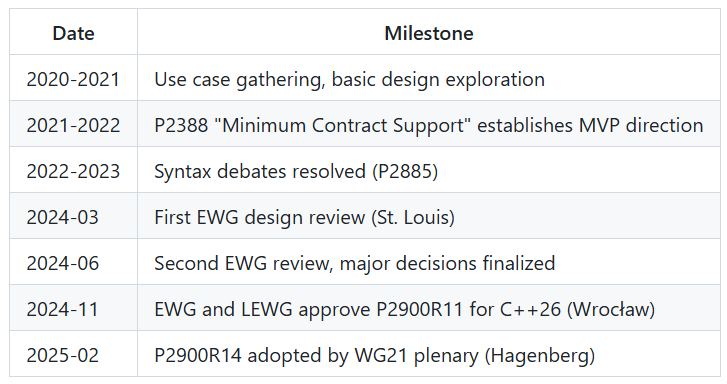
Design Evolution (2020-2024):
Competing Proposals:
Not everyone agreed with P2900’s direction:
P2680 (Gabriel Dos Reis): “Contracts for C++: Prioritizing Safety”—proposed “strict” contracts with stronger UB protections
P3285: Extension of P2680’s strict/relaxed model
P3265: “Ship Contracts in a TS”—proposed deferring to a Technical Specification
P3573: “Contract concerns”—raised late objections (Stroustrup among authors)
P3829: “Contracts do not belong in the language” (Dos Reis, Voutilainen, Spicer, Garcia, Chisnall)
The Hagenberg Adoption (February 2025):
Despite sustained opposition, P2900R14 was adopted. As the rationale document notes:
“At the end of this session, EWG took a poll on whether, given the sustained opposition, the Contracts proposal should be withdrawn from consideration for C++26, and consensus was not to do so.”
Virtual functions were excluded, with work continuing on that extension.
3. Key Individuals and Their Roles
3.1 John Lakos (Bloomberg)
Lakos represents the deepest practical experience with contract-based programming at scale. His contributions span:
2001: Created Bloomberg’s BDE group
2004: Conceived
bde_assert2013-2015: Led committee proposals (N3604, N4075, N4135, N4378)
2016: Co-author of P0380 merger
2018-present: Continued advocacy through P1429, P1332, P2755
Lakos embodies the “narrow contracts” philosophy—that undefined behavior in interfaces is acceptable and even desirable when combined with defensive programming and configurable assertion checking.
3.2 Gabriel Dos Reis (Texas A&M → Microsoft)
Dos Reis brought academic rigor and corporate resources:
2015: N4435 “Proposing Contract Attributes” (Microsoft SAL experience)
2016: Co-led P0380 merger
2017-2018: Co-author of P0542
2022-present: P2680 “Prioritizing Safety,” advocating for stricter contracts
His P2680 represented a philosophical divergence from P2900, emphasizing static analysis and UB elimination over runtime checking flexibility.
3.3 Bjarne Stroustrup (Language Creator)
Stroustrup’s involvement in contracts has been consistent but constrained:
2016: Co-author of P0380
2017-2018: Co-author of P0542
2025: Co-author of P3573 “Contract concerns”
His late opposition (P3573) illustrates the limits of “borrowed power”—even the language creator cannot unilaterally shape outcomes when committee consensus has formed.
3.4 Joshua Berne (Bloomberg)
Berne emerged as a central figure in the post-2019 redesign:
P1332R0 (2018): “Contract Checking in C++: A (long-term) Road Map”
P1429 (2019): “Contracts That Work”
P2751, P2811, P2877, P2932: Multiple foundational P2900 papers
Lead author of P2900
His sustained effort over six years represents the “owned power” that ultimately drove standardization.
3.5 Timur Doumler (JetBrains → Independent)
Doumler brought communication skills and process leadership:
SG21 co-chair
CppCast co-host (community communication)
P2885: “Requirements for a Contracts syntax”
Co-author of P2900
Author of explanatory materials (”Contracts for C++ explained in 5 minutes”)
3.6 John Spicer (Edison Design Group)
As SG21 chair, Spicer provided neutral leadership through contentious debates, leveraging his position as a compiler vendor representative with no direct stake in the design outcome.
4. Corporate Dynamics
4.1 Bloomberg’s Dominant Role
Bloomberg’s influence on contracts is unparalleled among corporations:
Human resources: Lakos, Berne, Meredith, Myers, Khlebnikov, Halpern, and others Practical experience: Decades of bsls_assert deployment across thousands of developers Philosophical foundation: The narrow-contracts/defensive-programming paradigm
This concentration created both benefits (deep practical knowledge) and concerns (single-company dominance of direction).
4.2 Microsoft’s Contribution and Divergence
Microsoft contributed through Dos Reis:
SAL (Source Annotation Language) experience informed static-analysis aspects
P2680 proposed alternative direction emphasizing safety over flexibility
The divergence between P2680 and P2900 illustrates how corporate priorities (Microsoft’s safety emphasis vs. Bloomberg’s flexibility emphasis) can create parallel tracks.
4.3 Limited Corporate Investment Elsewhere
Unlike coroutines (Microsoft), modules (Microsoft/Google), or executors (NVIDIA/Meta), contracts lacked broad corporate championship. This may explain the prolonged timeline—no company invested in implementations beyond GCC’s academic effort.
5. Great Founder Theory Analysis
5.1 The Missing Founder
Contracts’ history reveals a founder vacuum. Unlike features with clear technical champions (Gor Nishanov for coroutines, Eric Niebler for ranges), contracts had:
Multiple co-equal authors: P0542 had six authors with different priorities
Philosophical divisions: Runtime checking vs. static analysis, flexible vs. strict semantics
No implementation authority: Bloomberg controlled BDE but not compilers; Microsoft had compilers but not committee consensus
In GFT terms, no individual possessed both the vision clarity to define the feature and the owned power (implementation control) to realize it.
5.2 The 2019 Collapse as Founder Vacuum Consequence
The Cologne collapse demonstrates what happens without authoritative technical leadership:
Multiple incompatible fixes: Over a dozen papers proposed different solutions
Last-minute direction change: P1607 adoption showed no stable design center
Trust erosion: Late changes “eroded trust in the proposed design”
Unanimous retreat: Removal was the only consensus achievable
Compare this to coroutines: when Google raised objections, Microsoft’s Gor Nishanov could defend and modify the design authoritatively because he controlled the implementation and understood every design tradeoff.
5.3 The Bloomberg Semi-Founder Model
Post-2019, Bloomberg’s team (Lakos, Berne) emerged as de facto founders:
Deep domain expertise: Decades of practical experience
Sustained commitment: Berne authored or co-authored dozens of papers over six years
Implementation knowledge: BDE provided practical validation
However, they lacked:
Compiler control: GCC/Clang implementations were separate efforts
Formal authority: SG21 operated by consensus, not founder direction
This “semi-founder” model proved sufficient to reach adoption but created ongoing controversy (P3573, P3829 opposition).
5.4 Borrowed vs. Owned Power
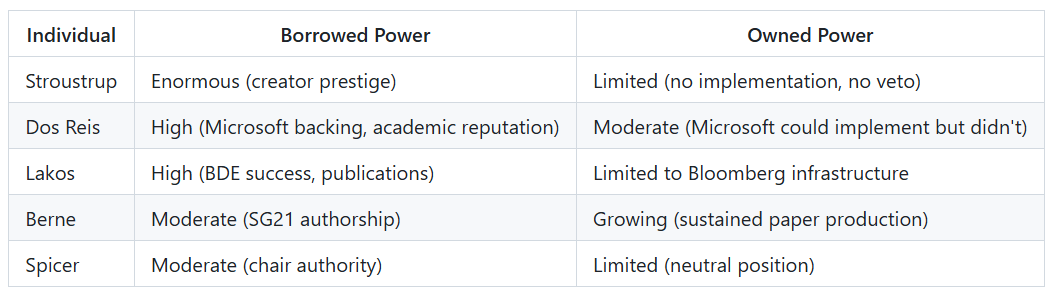
The pattern suggests borrowed power enables blocking but owned power enables completion. Bloomberg’s team had enough owned power (sustained effort, practical experience) to complete P2900 despite borrowed power opposition.
6. Process Effectiveness Assessment
6.1 What Failed
The 2018 Premature Adoption:
P0542 was adopted without:
Multiple production implementations
Consensus among authors on core semantics
Resolution of axiom/assume controversy
Evidence: The feature was removed less than a year after adoption.
The “Levels vs. Semantics” Design Gap:
The fundamental disagreement between “levels” (P0542) and “literal semantics” (P1429/P1607) was never resolved before adoption:
“The lack of consensus over a number of ‘controls’ (how continuation works, are levels enough or do we want ‘labels’ or ‘roles’ or ‘semantics’, when can contract conditions be ‘assumed’ by the compiler) meant that the entire P0542-contracts had to be removed.” (P2817)
The Late-Change Dynamic:
P1607’s adoption at the C++20 feature-freeze meeting demonstrated:
Insufficient time for reflection
Schedule pressure overriding quality
“Last minute and massive change” destroying consensus
6.2 What Worked (Eventually)
The SG21 Process:
Post-2019, SG21 employed:
Dedicated study group with neutral chair
Extensive use case gathering before design
MVP philosophy prioritizing consensus over completeness
Multi-year timeline allowing iteration
The MVP Philosophy:
By explicitly accepting incompleteness, SG21 avoided the “everything at once” trap:
“By definition, an MVP cannot satisfy all known use cases but is designed to satisfy basic use cases from the start and simultaneously to allow satisfying other important use cases via future extensions.” (P2899R1)
Implementation-Informed Design:
GCC and Clang forks implemented P2900, providing feedback before final adoption (P3460R0).
6.3 Quantified Dysfunction
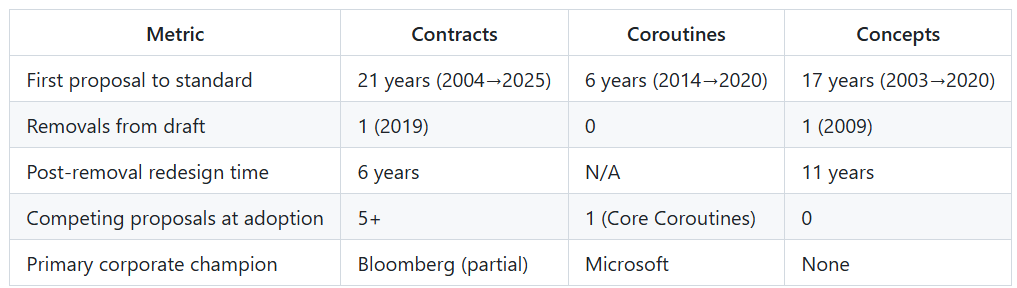
Contracts’ timeline exceeded even the notoriously troubled Concepts feature. The 2019 removal directly caused a six-year delay.
7. Structural Problems Identified
7.1 The Multi-Stakeholder Design Problem
Contracts attempted to satisfy fundamentally different use cases:
Runtime checking (Bloomberg philosophy): Configurable assertion checking, violation handlers
Static analysis (Microsoft philosophy): Compiler-verifiable properties, UB elimination
Optimization hints (assume semantics): Performance-oriented undefined behavior
Documentation (axiom philosophy): Human-readable interface contracts
No mechanism existed to prioritize among these or to explicitly exclude some for later.
7.2 The Consensus Trap
WG21’s consensus requirement created deadlock:
Strong support for some contracts existed throughout
Strong opposition to any particular design existed throughout
Result: Years of churn with no progress
The 2019 evening session revealed:
“We don’t actually yet understand each other’s use cases well enough to be able to make any decision confidently.”
Understanding emerged only after the feature was removed.
7.3 The Schedule Pressure Problem
Both the 2018 adoption and 2019 removal were driven by schedule:
2018: “Add to C++20” pressure led to premature adoption
2019: Feature-freeze deadline forced decision without resolution
As P2899R1 notes regarding P1607:
“It is arguably a significant redesign, and the committee ultimately agreed that it was too late in the C++20 release cycle to approve such a redesign now.”
Schedule should serve design, not vice versa.
7.4 The Implementation Gap
Unlike coroutines (Microsoft had shipping implementation) or modules (Microsoft and Google had competing implementations), contracts had:
One academic implementation (GCC)
No production deployment of the standard design
No “vote with your feet” user feedback
Bloomberg’s BDE experience validated library-based contracts, not the language-based design being standardized.
8. Proposed Reforms
8.1 Mandatory Design Authority Assignment
Problem addressed: Multi-stakeholder deadlock without authoritative resolution.
Proposal: When a study group is formed for a major feature, the convener should appoint a “Design Authority” (individual or small team of 2-3) with:
Final decision authority on design disputes within the study group
Responsibility to present unified recommendations to EWG
Accountability for implementation coordination
Rationale: The SG21 process worked better than ad hoc EWG debate, but still lacked authoritative resolution. A named Design Authority could have resolved the levels/semantics debate in 2018-2019.
8.2 Implementation Before Working Draft Inclusion
Problem addressed: Adopting untested designs.
Proposal: Before any feature enters the working draft:
At least one quality implementation must exist
The implementation must be publicly available for experimentation
At least one release cycle of user feedback must be gathered
P2900’s progression (GCC/Clang forks → implementation papers → adoption) demonstrates this works. Make it mandatory.
8.3 Explicit Use Case Prioritization
Problem addressed: Attempting to satisfy incompatible use cases simultaneously.
Proposal: Major features must include explicit use case prioritization:
Primary use cases: Must be fully satisfied
Secondary use cases: Should be accommodated
Deferred use cases: Explicitly excluded from initial design
Non-goals: Use cases the design explicitly does not support
SG21’s MVP philosophy implicitly did this. Make it explicit and mandatory.
8.4 Time-Bounded Study Group Authority
Problem addressed: Indefinite churn without resolution.
Proposal: Study groups receive a fixed mandate (e.g., 3 years) with:
Clear deliverables defined at creation
Mandatory progress reviews at 12-month intervals
Extension requires explicit committee vote
Dissolution if deliverables not achieved
This prevents features from languishing indefinitely while consuming committee resources.
8.5 Competing Proposal Process
Problem addressed: Late competing proposals disrupting consensus.
Proposal: Once a proposal reaches EWG review:
Competing proposals must be filed within 60 days
EWG explicitly votes to select a direction
Non-selected proposals may return only in the next release cycle
Late papers (after direction vote) require 2/3 supermajority to consider
This prevents the “dozen papers on the table” scenario that collapsed C++20 contracts.
9. Is the ISO Process Viable?
9.1 The Case for Reform Within ISO
Arguments:
SG21 succeeded eventually: The study group model produced P2900
MVP philosophy works: Explicit scoping achieved consensus
Implementation feedback helps: GCC/Clang forks informed design
ISO legitimacy matters: Standard status enables adoption
Assessment: The post-2019 process worked, albeit slowly. The problem was 2018-2019, not the ISO framework itself.
9.2 The Case for Alternative Governance
Arguments:
21 years is unacceptable: Other languages (Rust, Go) ship features in months
Sustained opposition continues: P3573, P3829 show contracts remains contested even post-adoption
Volunteer burnout: Six years of Berne’s papers represents unsustainable individual effort
Corporate dominance: Bloomberg’s philosophy prevailed through attrition
Assessment: The current process can produce results but at costs (time, volunteer effort, acrimony) that may be unsustainable as feature complexity increases.
9.3 A Federated Model Alternative
We propose a federated governance model that separates experimentation from standardization:
Layer 1: Experimental Features (outside ISO)
Managed by a C++ Evolution Foundation
Six-month release cycles
Features flagged as experimental/stable
Compiler vendors opt-in to experimental features
User feedback drives stability promotion
Layer 2: ISO Standardization
Considers only “stable” features from Layer 1
Three-year cycles maintained
Provides legal/procurement guarantees
Focus on wording and formal specification
Advantages:
Faster experimentation: New ideas ship in months, not decades
User feedback loop: Real deployment informs design
Reduced committee burden: ISO focuses on proven features
Volunteer sustainability: Shorter cycles reduce burnout
Contracts under this model:
2016-2017: P0380 design ships experimentally in one compiler
2017-2018: User feedback reveals axiom/assume problems
2018-2019: Redesign ships experimentally, iteration continues
2020: Stable design emerges from field experience
2023: ISO adopts proven design
Estimated time savings: 5-10 years vs. actual trajectory.
9.4 Comparison to Rust/TC39 Models
Rust:
RFC process requires implementation before stabilization
Edition mechanism allows breaking changes within compatibility guarantees
Federated teams with clear authority domains
Result: Major features (async/await, const generics) ship in 2-4 years
TC39 (JavaScript):
Staged proposal process (0-4)
Browser implementation required before Stage 4
Six-month release cycles absorb incremental changes
Result: Complex features (modules, async/await) ship in 3-5 years
C++ could adopt:
Rust’s “implementation required” discipline
TC39’s staged process with clear criteria
Both models’ shorter iteration cycles
10. Conclusion
The 21-year journey of C++ Contracts reveals both the strengths and limitations of WG21’s processes:
Strengths demonstrated:
Deep technical analysis
Multiple implementation perspectives
Eventually, consensus achievement
Limitations revealed:
Inability to resolve multi-stakeholder disputes efficiently
Schedule pressure corrupting design quality
Volunteer effort unsustainability
No mechanism for authoritative technical direction
The reforms proposed here—design authority assignment, implementation requirements, explicit use case prioritization, time-bounded mandates, and competing proposal discipline—could address observed dysfunction while preserving ISO standardization’s benefits.
The more fundamental question is whether C++ can afford another 21-year feature development cycle. Modern software development moves faster; languages that cannot evolve at comparable pace risk obsolescence regardless of technical merit.
Contracts will ship in C++26. The question is whether WG21 can learn from this experience to deliver future features in years rather than decades. The answer will determine whether C++ remains a viable choice for the next generation of systems software.
References
Committee Papers: Early Proposals
N1613: Ottosen. “Proposal to add Design by Contract to C++” (2004)
N1669, N1773, N1866, N1962: Contract Programming revisions (2004-2006)
N3604: Lakos, Zakharov. “Centralized Defensive-Programming Support” (2013)
N4075, N4135, N4378: Language-based contracts proposals (2014-2015)
Committee Papers: P0542 Era
P0380: Dos Reis, Garcia, Lakos, Meredith, Myers, Stroustrup. “A contract design” (2016)
P0542R5: “Support for contract based programming in C++” (2018)
P1289R1: Garcia, Voutilainen. “Access control in contract conditions” (2018)
P1323R2: Tong. “Contract postconditions and return type deduction” (2019)
Committee Papers: 2019 Crisis
P1429: Berne, Lakos. “Contracts That Work” (2019)
P1607: “Minimizing contracts” (2019)
P1823R0: “Remove Contracts from C++20” (2019)
Committee Papers: P2900 Development
P2388: Krzemieński, Ažman. “Minimum Contract Support” (2021)
P2521: “Contract support — Working Paper” (multiple revisions)
P2680: Dos Reis. “Contracts for C++: Prioritizing Safety” (2022)
P2817: Krzemieński. “The idea behind the contracts MVP” (2023)
P2885: Doumler et al. “Requirements for a Contracts syntax” (2023)
P2899R1: “Contracts for C++ — Rationale” (2025)
P2900R14: “Contracts for C++” (2025)
Committee Papers: Opposition
P3173: Dos Reis. “P2900R6 May Be Minimal, but It Is Not Viable” (2024)
P3265: Voutilainen. “Ship Contracts in a TS” (2024)
P3285: “Contracts Protecting The Protector” (2024)
P3362: Voutilainen. “Static analysis and ‘safety’ of Contracts” (2024)
P3573: “Contract concerns” (2025)
P3829: Chisnall, Spicer, Dos Reis, Voutilainen, Garcia. “Contracts do not belong in the language” (2025)
Trip Reports and Commentary
Doumler, T. “Trip report: July 2019 ISO C++ committee meeting, Cologne” (2019)
Sutter, H. “Trip report: February 2025 ISO C++ meeting, Hagenberg” (2025)
Ballo, B. “Trip Report: C++ Standards Meeting in Cologne, July 2019”
Secondary Sources
P1487: “Bloomberg and Contracts: A historical timeline” (2019)
Bloomberg. “Contracts, Undefined Behavior, and Defensive Programming” (white paper)
Lakos, J. “Large-Scale C++ Software Design” (1996)
Burja, S. Great Founder Theory (2020)
The views expressed in this paper are those of the authors. We welcome comment, correction, and debate.